Money is the most powerful technology a country can own, and for fifty years the United States has owned the best version of it ever built. Not gold, not land, not factories — the dollar itself, wired into the price of the one commodity every economy on earth must buy: oil. That arrangement has a name, the petrodollar, and it has quietly underwritten American prosperity, American deficits, and American power since the 1970s.
That foundation is now being tested in a way it has not been in living memory. Central banks — the most conservative, slow-moving institutions on the planet — are doing something they have not done at this scale in generations: they are trading their paper claims on the dollar for physical gold, and they are doing it deliberately, year after year. At the same time, a growing bloc of nations is openly experimenting with settling trade outside the dollar entirely. And it is all happening against the backdrop of a U.S. debt load that has climbed past every previous record in the nation's history.
Pile those three forces on top of one another — gold accumulation, de-dollarization, and record debt — and you get a structure under real stress. The argument of this piece is not that the dollar collapses next Tuesday; it almost certainly does not. The argument is subtler and, in some ways, more unsettling: a system this large rarely breaks all at once. It breaks the way a row of dominoes falls. One confidence shock, one failed auction, one major exporter that decides it no longer needs dollars — and the rest can follow faster than anyone planned for. To understand why that first domino matters so much, you have to understand how the whole row got stacked in the first place.
Quick Takeaways
- The petrodollar system — oil priced in dollars, surpluses recycled into U.S. debt — was born from two events: the 1971 Nixon Shock and the 1974 U.S.–Saudi arrangement.
- That system handed America an "exorbitant privilege": permanent global demand for its currency and its bonds, which made decades of deficits financeable.
- Central banks have bought more than 1,000 tonnes of gold in a single year — the heaviest buying in modern records — and kept that pace up since 2022.
- The dollar's share of global reserves has slid from over 70% around 2000 to under 60% today, even as no single rival has replaced it.
- U.S. federal debt now sits north of $36 trillion — roughly 120% of GDP — with interest costs that now rival the entire defense budget.
- A petrodollar unwind likely wouldn't be a single crash but a cascade: weaker dollar demand → higher yields → higher interest costs → more borrowing. The "first domino" is a confidence shock, not a calendar date.
How the Dollar Married Oil: 1944–1974
To see why gold is suddenly a threat, you have to rewind to a world where gold was the system — and watch how the United States replaced it with something better for itself.
Bretton Woods and the Dollar–Gold Anchor (1944)
In the summer of 1944, with the Second World War not yet won, delegates from forty-four nations met at a resort in Bretton Woods, New Hampshire, to design the financial architecture of the postwar world. The deal they struck was elegant: the U.S. dollar would be pegged to gold at a fixed $35 an ounce, and every other major currency would peg itself to the dollar. The dollar became, in effect, the world's gold receipt — as good as bullion, but easier to hold, easier to lend, and backed by the only large economy left standing intact. America emerged from the war holding the lion's share of the world's monetary gold, and the system simply ratified the reality of that power.
For a quarter-century it worked. But it carried a fatal arithmetic problem. As global trade expanded, the world needed ever more dollars to grease it — yet the U.S. gold pile was finite. By the late 1960s, the dollars circulating abroad vastly exceeded the gold sitting in Fort Knox to redeem them. Foreign governments, France most loudly among them, began to notice, and to ask for their gold back.
The Nixon Shock: Closing the Gold Window (1971)
On August 15, 1971, President Richard Nixon went on television and severed the link. The United States would no longer redeem dollars for gold — the "gold window" was closed, supposedly as a temporary measure. It was never reopened. In a single announcement, the dollar went from a claim on metal to a pure promise: a fiat currency, backed by nothing but the credibility and economic might of the issuing government.
This is the hinge on which the whole modern story turns. A currency anchored to gold disciplines its issuer — you cannot print what you cannot back. A fiat currency removes that discipline entirely. The question that hung over the early 1970s was brutal and simple: with the gold anchor gone, why would the rest of the world keep holding dollars at all?
The Petrodollar Bargain (1973–1974)
The answer came from the desert. The 1973 oil embargo had quadrupled crude prices and handed the oil-exporting nations of the Persian Gulf an extraordinary windfall — and a problem: what to do with rivers of new revenue. Washington's solution, formalized in a 1974 arrangement with Saudi Arabia and soon extended across OPEC, was a bargain of remarkable simplicity. The United States would provide military protection and security guarantees. In return, oil would continue to be priced and sold in U.S. dollars, and the resulting surpluses — "petrodollars" — would be recycled back into U.S. Treasury securities and American banks.
With that handshake, the dollar found a new anchor. Not gold this time, but oil — the one commodity no industrial economy can live without. Every nation that needed to import energy now needed dollars to pay for it, whether it traded with America or not. Demand for the currency was no longer a favor; it was a structural necessity baked into the plumbing of the global economy.
Why the Petrodollar Became the Engine of American Power
It is hard to overstate what this arrangement gave the United States. Economists call it the "exorbitant privilege," a phrase coined in the 1960s, and the petrodollar supercharged it. Because the world needed dollars to buy oil and dollars to settle trade, foreigners had to accumulate them — and the safest place to park dollars is U.S. government debt. That created a vast, permanent, price-insensitive buyer for Treasury bonds.
Think about what that means in practice. A normal country that runs large deficits eventually scares off its lenders; interest rates spike, the currency falls, and discipline is forced from outside. The United States largely escaped that gravity. It could run trade deficits and budget deficits for decades because the rest of the world needed to hold the very instrument it was issuing. America could import real goods — cars, electronics, oil — and pay with dollars that trading partners then lent right back. It is the closest thing to a financial perpetual-motion machine any nation has ever operated.
The privilege came with a weapon attached. Because dollar payments ultimately clear through the U.S. financial system, Washington gained the ability to cut adversaries off from global commerce with the stroke of a pen — sanctions with teeth no army could match. For decades, that power looked like an unambiguous asset. More recently, it has started to look like the reason other nations are building exits.
The Quiet Migration: Central Banks Are Buying Gold Again
Here is where the present chapter begins. For most of the post-1971 era, gold was treated as a relic — a "barbarous relic," in the old jibe — something central banks held out of habit and occasionally sold. That has reversed, hard.
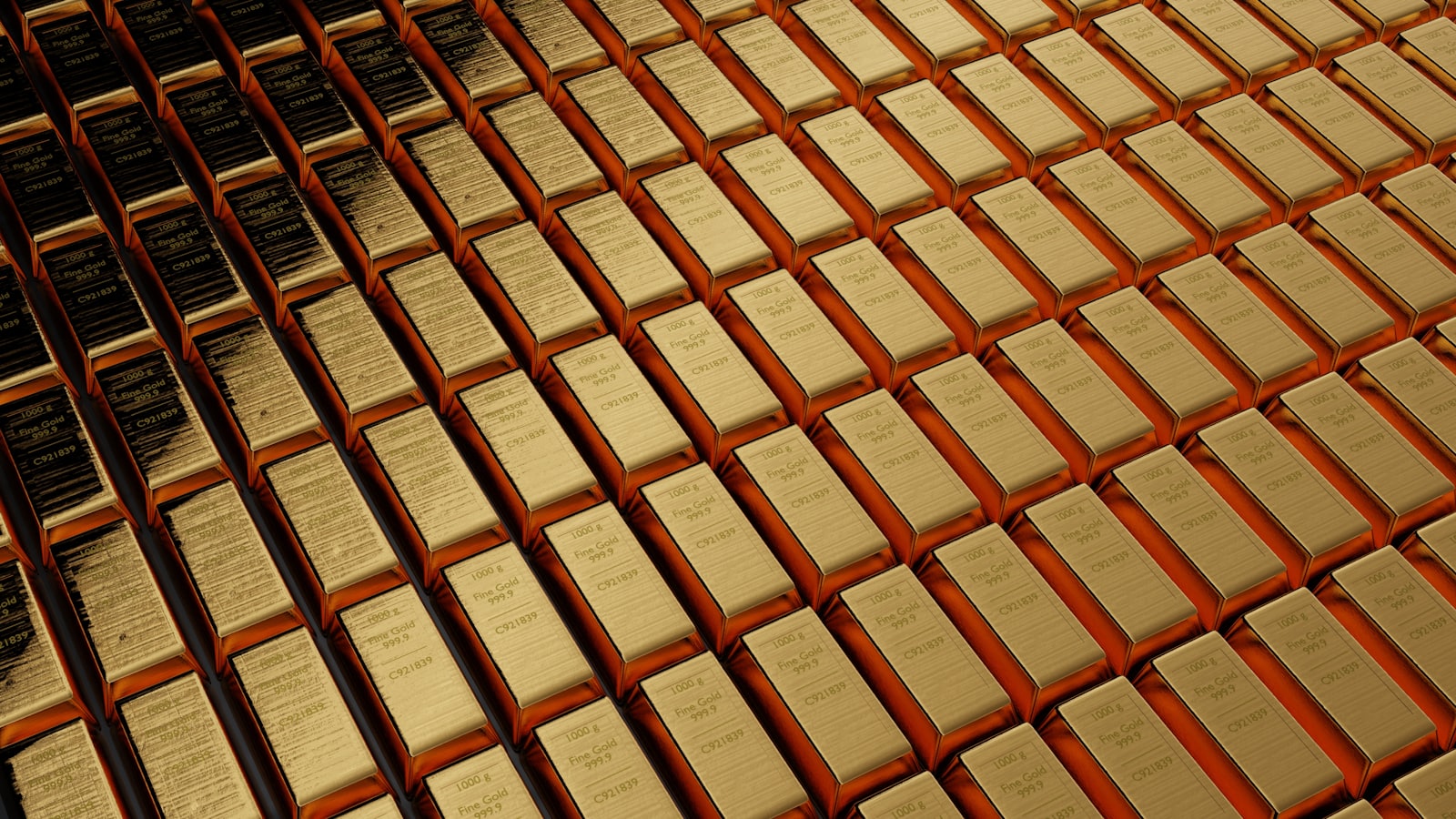
Since 2022, the world's central banks have been net buyers of gold at a pace not seen in modern record-keeping, adding more than a thousand tonnes in a single year and sustaining that appetite since. This is not retail speculation or jewelry demand; it is the most cautious institutions on earth voting, with real money, to hold less paper and more metal. Gold has one property no other reserve asset shares: it is nobody's liability. It cannot be frozen by a foreign government, inflated away by a foreign central bank, or sanctioned out of existence.
That last point is not academic. When a major economy's foreign reserves were frozen in 2022 in response to the war in Ukraine, every reserve manager on the planet absorbed the same lesson at the same moment: dollars held abroad are only as safe as your political relationship with Washington. Gold in your own vault carries no such condition. The buying spree that followed is the rational response of institutions that just watched the rules of the game change in real time.
Gold is only half the migration. The other half is happening in the pipes of trade settlement. An expanded BRICS bloc — Brazil, Russia, India, China, South Africa and newer members — now openly discusses conducting more of its commerce in local currencies rather than dollars. There have been reports of oil and other commodities being priced or settled in yuan, rupees, and dirhams. None of this has dethroned the dollar. But each bilateral workaround chips a little demand off the structure, and each one makes the next one easier to build.
The Debt Overhang: An All-Time High
Now add the variable that turns a slow drift into a real fragility. The exorbitant privilege only works if the world keeps wanting to hold U.S. debt. And the United States has never leaned on that willingness as heavily as it does today.
Federal debt has climbed past $36 trillion — an all-time high in absolute terms, and roughly 120% of the entire economy's annual output. To finance it, the Treasury must continuously roll over trillions in maturing bonds and sell trillions more to cover ongoing deficits. As interest rates normalized off their historic lows, the cost of carrying all that debt exploded: net interest payments have climbed to a level that now rivals — and by some measures exceeds — the entire U.S. defense budget. Every dollar spent servicing old debt is a dollar not spent on anything else, and a dollar that itself must often be borrowed.
This is the mathematical trap. Higher debt requires more borrowing; more borrowing in a higher-rate world means higher interest costs; higher interest costs widen the deficit; a wider deficit demands still more borrowing. It is a loop that only stays benign as long as buyers show up at every auction, reliably, at yields the Treasury can afford. The petrodollar system is precisely what guaranteed those buyers for fifty years. Which is why the gold migration and the debt pile are not two separate stories — they are the same story, viewed from opposite ends.
The First Domino: How an Unwind Could Cascade
So what does the feared scenario actually look like? Not, in all likelihood, a single dramatic morning when the dollar is "replaced." It looks like a sequence — each step modest on its own, dangerous in combination.
- Marginal demand fades. A handful of large exporters settle more oil and trade outside the dollar; reserve managers keep shifting incremental savings into gold rather than Treasuries. Nothing collapses. The pool of automatic buyers simply stops growing the way it always did.
- Yields have to rise to clear. With less price-insensitive demand, the Treasury must offer higher interest rates to sell the same volume of bonds. Borrowing costs climb across the whole economy, because Treasury yields are the benchmark beneath mortgages, car loans, and business credit.
- The interest bill compounds. Higher yields on a $36-trillion-and-rising debt mean the fastest-growing line in the federal budget is interest itself — crowding out everything else and forcing yet more issuance to cover it.
- Confidence becomes the variable. At some threshold, lenders start to ask whether the math is sustainable. If enough of them hesitate at once — a weak auction, a credit downgrade, a geopolitical break — the drift becomes a stampede. That hesitation is the first domino. It is psychological, it is sudden, and it is exactly the kind of thing that is invisible right up until the moment it isn't.
- The dollar weakens, and inflation imports itself. A falling dollar makes everything America imports — including oil — more expensive, feeding domestic inflation precisely when the government most needs low rates to manage its debt. The central bank is caught between fighting inflation and protecting the Treasury. There is no clean way out of that box.
That is the mechanism behind the instinct that this "could be very bad." It is not mysticism about gold. It is the cold arithmetic of a borrower who has grown dependent on a captive lender, at the exact moment that lender is quietly looking for the door.
| Pillar | The petrodollar era | A multipolar / gold-leaning drift |
|---|---|---|
| Oil pricing | Overwhelmingly in U.S. dollars | Growing slice in yuan, rupees, dirhams, local pairs |
| Reserve asset of choice | U.S. Treasuries above all | Diversified — gold absorbing the marginal flow |
| Demand for U.S. debt | Structural, near-automatic | Increasingly price-sensitive and political |
| U.S. borrowing cost | Suppressed by captive buyers | Higher, more volatile, confidence-driven |
| Sanctions leverage | Near-absolute via dollar clearing | Eroded as trade routes around the dollar |
The Counterargument: Why the Dollar Won't Die Tomorrow
Intellectual honesty demands the other side of the ledger, because the "imminent collapse" version of this story is sold far too cheaply. The dollar's dominance rests on advantages no rival has come close to matching.
The U.S. Treasury market is the deepest, most liquid pool of safe assets in the history of finance — there is simply nowhere else to park trillions on short notice. The most-discussed alternative, China's yuan, remains hemmed in by capital controls that make it unattractive as a true reserve currency; a reserve asset you cannot freely move is a contradiction in terms. The euro carries the structural fault line of a shared currency without a shared treasury. And gold, for all its symbolism, is clumsy to transact in at the scale of modern trade — you cannot wire a bar of bullion to settle a container ship. Network effects are ferociously sticky: the world uses dollars in part simply because the world uses dollars.
All of which is why the realistic risk is not replacement but erosion — a slow loss of the exorbitant privilege rather than a sudden coup. But erosion is not harmless. A privilege you have built fifty years of habits, deficits, and assumptions around does not have to vanish to hurt; it only has to shrink faster than you have planned for. The danger of the first domino is not that the dollar stops being important. It is that it stops being unquestioned — and a heavily indebted government has very little margin for the difference.
What a Shifting Monetary Order Means for Main Street
If you run a small business, all of this can feel like weather happening far above your roof. It isn't. The monetary order is not an abstraction; it transmits directly into the two things every operator feels — the price of money and the price of goods.
A world of higher, more volatile interest rates is a world where bank credit gets more expensive and more cautious, exactly the conditions in which traditional lenders pull back hardest on small businesses. A world of imported inflation is one where your inventory, equipment, and payroll costs lurch unpredictably, and where a sudden need for working capital can arrive with no warning. The lesson of every monetary regime change in history is the same for the people on the ground: resilience comes from optionality. The businesses that weather turbulence are not the ones with the cheapest possible financing in calm times — they are the ones that are not dependent on a single source of capital that can disappear when the climate turns.
That is not a reason to panic, and it is emphatically not a prediction about what gold or the dollar will do next quarter. It is a reason to make sure your business has more than one door to capital before you ever need to walk through one.
Don't let your only funding option be the one that disappears in a downturn.
Send four months of bank statements. We'll map the funding paths your business actually qualifies for — so you have options ready before you need them, not after.
See What You Qualify For →The Bottom Line, Plainly
The petrodollar was a masterstroke — a way to keep the world demanding dollars after the gold anchor was cut loose in 1971, anchored instead to oil through the 1974 bargain. For fifty years it gave America a privilege no other nation has ever enjoyed: the ability to borrow nearly without limit because the world had no choice but to lend. That privilege is not gone. But for the first time in two generations, the world's central banks are visibly hedging against it — buying gold at a record pace, building trade routes around the dollar, and doing it just as U.S. debt reaches an all-time high.
None of that guarantees a crisis. The dollar's advantages remain real and deep, and the most likely path is erosion, not collapse. But a system this large and this leveraged does not require a collapse to cause real pain — it only requires a loss of confidence at the margin, the first domino, at the worst possible moment. The prudent posture, for a nation and for a business alike, is the same: don't assume the easy money of the last fifty years is the natural state of the world, and don't be caught with only one source of capital when the ground shifts.
Watch the gold. Watch the auctions. And whatever the macro weather does, make sure your own business has options. Tell us where you stand and we'll show you what's available — or keep reading on our blog.